Imagine you lead a product team of six that has worked together for two years. In meetings Ethan argues hard for his plan, Maya agrees, and the team leaves with a decision. Two weeks later the decision has stalled, because Maya never bought in and nobody said so out loud. The pattern has held for three quarters, and the usual explanation is that Maya is slow to commit and Ethan is a strong personality. The profile gives you a different explanation.
Every member of the team completes the assessment, and the team receives its own scores on all five behaviors. On this team, four of the six members say they sometimes don't buy in to decisions because the team is not clear about its priorities. Ethan's DiSC® pages explain the stalled decisions from his side. The team then works on the pattern together, starting with Trust at the base of the model.

What Ethan sees in his profile
Ethan reads that his team scored lowest on Accountability and Trust. His commitment page says that, having had his say, Ethan may assume everyone is as confident as he is in the decision, while S-style colleagues like Maya want to be absolutely sure before they commit. His conflict page warns that his approach may overwhelm S-style colleagues, causing them to give in simply to avoid prolonging the conflict. The advice on the page is direct: don't interpret their silence as a resolution to conflict.

What the team leader sees in the team reports
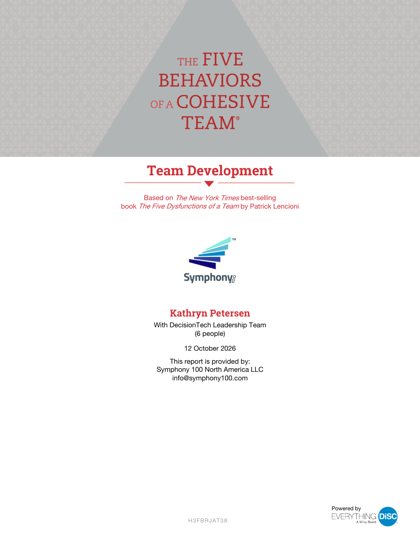
As the team leader, you receive the team reports with the profiles you buy from Symphony 100. The Annotated Team Report is the same report the team members receive, with notes on every page to guide the session, and appendices the team does not see: all 20 statements ranked by team average, and the team's percentile on each behavior compared with other teams. At least six weeks after the original assessment, the team can take the Progress Report and see how its behaviors have changed.







 See a sample
 See a sample
 See a sample
 See a sample
 $795 or $1,095 per session
 Authorized Partner