Three sentences people say in a workplace where conflict goes underground.
“I just avoid him. Avoiding him is easier.”
“Every meeting turns into the same argument.”
“I said nothing in the room and complained afterwards.”
START HERE
Two parts: the Productive Conflict profile, and the live workshop built on the profile
Everything DiSC® Productive Conflict combines the personalized insights of DiSC® with the proven science of cognitive behavioral theory. The program does not teach a step-by-step process for conflict resolution. Each participant learns personal techniques to curb destructive behaviors, so conflict becomes more productive. Each participant receives a 22-page profile on the destructive and productive conflict behaviors of each DiSC® style.
The Workshop Package takes your group through the profile in three live, online sessions for your own cohort of up to 10. The first session covers DiSC® in conflict, the second session covers destructive responses, and the third session covers changing your response.
How a conflict goes wrong, and how a person changes the response
THE CONFLICT
A colleague pushes back
A colleague challenges your proposal in front of the team.
AUTOMATIC THOUGHT
A thought arrives first
If they push me, I’ll push back harder.
NO PAUSE
The thought drives the behavior
The automatic thought and the emotion around the thought push the person toward a knee-jerk response.
DESTRUCTIVE RESPONSE
Arguing
The exchange centers more on winning than on finding the best solution.
FIRST STEP BACK, THEN REFRAME
A different thought
Maybe they don’t realize how aggressively they’re coming across.
PRODUCTIVE RESPONSE
A chosen response
The person is back in control and chooses a productive response, such as listening or determining the root of the problem.
Symphony 100 illustration of the model in the Everything DiSC® Productive Conflict profile. The two thoughts are examples from Wiley's sample profile for the D style.
Destructive responses the profile covers
ArguingBelittlingCaving inDefensivenessDismissing others’ opinionsBecoming overly dramaticExaggerating the problemExclusionFinger-pointingGossipingBecoming hypercriticalOverpoweringPassive-aggressionRevengeSabotageSarcasmStonewallingWithdrawing
Productive responses participants practice
ApologizingFinding compromisesDetermining the root of the problemCommunicating openly and honestlyStepping back to reflectSeparating emotions from factsTaking ownership of your partShowing flexibilityGiving people time and spaceRevisiting unresolved issuesAcknowledging others’ feelingsCommunicating respectfullySeeking active resolutionBeing aware of your feelingsGiving reassuranceListening
Three questions for reframing. Is this thought actually valid? Am I overreacting or exaggerating the problem? Is there another way I could look at the situation?
WHO IT IS FOR
Anyone who works with other people
Workplace conflict is uncomfortable and unavoidable. The workshop is about each person's own response to conflict, so the participants can be one team or a mixed group from across the organization.
Leaders and managers
Imagine you manage two strong people who no longer speak to each other. The workshop shows you your own conflict behaviors first, so you can model a productive response for your team.
Aspiring leaders
Imagine you are about to lead a team for the first time. The workshop prepares you to handle disagreement before the first hard conversation arrives.
A team under pressure
Imagine you run a startup team with tight deadlines. Disagreements are frequent, and the team needs disagreements to produce better decisions and not lasting damage.
HR and people teams
Imagine you are the person colleagues come to when a conflict escalates. The workshop gives the organization one language for conflict, so fewer conflicts reach your desk.
PURPOSE AND KEY OBJECTIVES
What the workshop is for
Organizations book this workshop for a business reason: destructive conflict costs money. People avoid one another, decisions are delayed, good ideas go unspoken, and capable people leave.
The purpose of the Workshop Package is to help participants turn destructive conflict behavior into productive responses, so more of the organization's time and energy goes into the outcomes it is measured on: productivity, retention and, in the end, profitability.
To get there, by the end of the three sessions participants will:
1
Understand self and others in conflict
Each participant understands how the participant's own DiSC® style shapes the response to conflict, and how other styles respond.
2
Recognize destructive behaviors
Participants recognize their own destructive responses and the automatic thoughts behind the responses.
3
Step back and reframe
Participants practice stepping back from the emotion and reframing the automatic thought.
4
Choose a productive response
Each participant leaves with productive responses to call on and a personal plan.
Your objectives may differ. Symphony 100 discusses these objectives with you up front. If your group has different priorities, the objectives and the emphasis of the sessions are adjusted to match. Results vary with each group's culture, participation and follow-through: results disclaimer.
WHY A WORKSHOP
Why not just read the profiles on your own?
Imagine every participant has read the participant's own 22-page profile. Each person now knows the person's own destructive habits. The next disagreement arrives on a busy Tuesday, and the old habit wins, because nobody has practiced the new response.
Practice in a safe setting. Participants work through realistic conflict scenarios before a real conflict arrives.
Seeing the other styles. Participants hear how colleagues with other DiSC® styles experience the same conflict.
An experienced facilitator. The facilitator keeps a sensitive subject productive and tied to real work.
A shared language. The group leaves with common words for destructive and productive responses.
WHO FACILITATES
Facilitated by a Certified Everything DiSC® Practitioner
Every Productive Conflict Workshop Package is facilitated by a Certified Everything DiSC® Practitioner. From time to time, a producer assists the facilitator to keep the delivery smooth and professional.
Three live, online sessions of 90 minutes each on a private Zoom link, facilitated by a Certified Everything DiSC® Practitioner
10 Everything DiSC® Productive Conflict assessments and profiles: a personal 22-page profile for each participant
10 MyEverythingDiSC® accounts, the interactive learning portal for ongoing learning after the sessions
Realistic conflict scenarios and group exercises in every session
A personal plan for each participant
THE LIVE SESSIONS
Three sessions, from your style in conflict to a personal plan
The three sessions, four and a half hours in total, run live and online on a private Zoom link, with polls, breakout discussions and realistic scenarios. The sessions follow Wiley's three Productive Conflict modules. Choose a session to see the session's topics.
SESSION 1 · 90 MINUTES · DiSC® IN CONFLICT
DiSC® in conflict
Participants learn how each DiSC® style behaves in conflict.
1
Welcome and who is whoEach participant introduces the participant's role, so the facilitator and the group know who is in the room.
2
The DiSC® modelParticipants explore the model and their own DiSC® styles.
3
Your style in conflictParticipants identify the priorities and motivators that shape their behavior in a hard interaction.
4
The other styles in conflictParticipants see how colleagues with other styles experience the same conflict.
Key outcome. Each participant understands how the participant's own DiSC® style shapes the response to conflict.
SESSION 2 · 90 MINUTES · DESTRUCTIVE RESPONSES
Destructive responses
Participants look at what happens before a destructive response.
1
Check-inWhat participants noticed about conflict since Session 1.
2
Destructive responsesParticipants identify the destructive responses they use, such as defensiveness or withdrawing.
3
Automatic thoughtsParticipants trace each response back to the automatic thought that leads to the response.
4
Early signsParticipants learn to recognize the early signs of a destructive response.
Key outcome. Each participant can name the participant's own destructive responses and the automatic thoughts behind the responses.
SESSION 3 · 90 MINUTES · CHANGING YOUR RESPONSE
Changing your response
Participants practice a different response.
1
Check-inOne automatic thought each participant caught since Session 2.
2
Stepping backParticipants look at how anger and anxiety influence judgment in a conflict.
3
ReframingParticipants practice reframing automatic thoughts with three questions.
4
Productive responses and a personal planEach participant chooses productive responses to use and writes a personal plan.
Key outcome. Each participant leaves with a personal plan for handling conflict in a more productive way.
A guide, not a script. The time spent on each topic varies with the group, so the facilitator adjusts the pace to your group. Symphony 100 also reviews this syllabus on a regular basis and adjusts the topics and activities to better meet clients' needs, so the outline above is subject to change.
THE PLATFORM
After the sessions: MyEverythingDiSC®
Everything DiSC® Productive Conflict runs on MyEverythingDiSC®, the interactive learning portal that is exclusive to the Everything DiSC® product suite. Productive Conflict is not on the Catalyst™ platform. A MyEverythingDiSC® account is included for each participant, and each participant keeps the account after the sessions end.
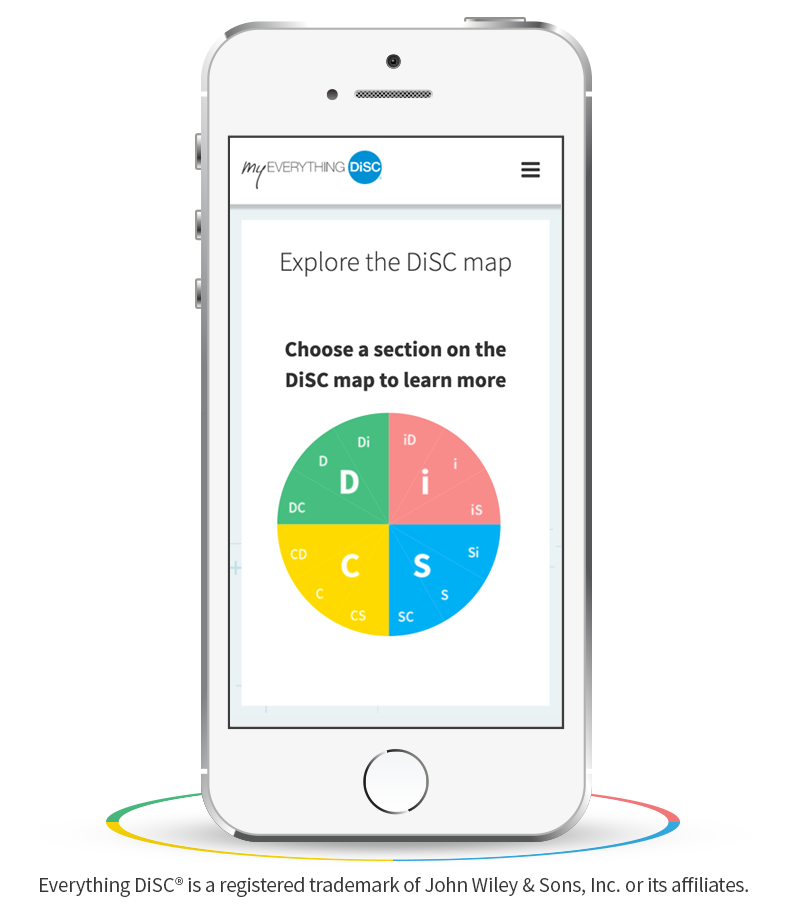
The profile, on any device
Each participant opens the participant's own profile at any time, on a computer, a tablet or a phone.
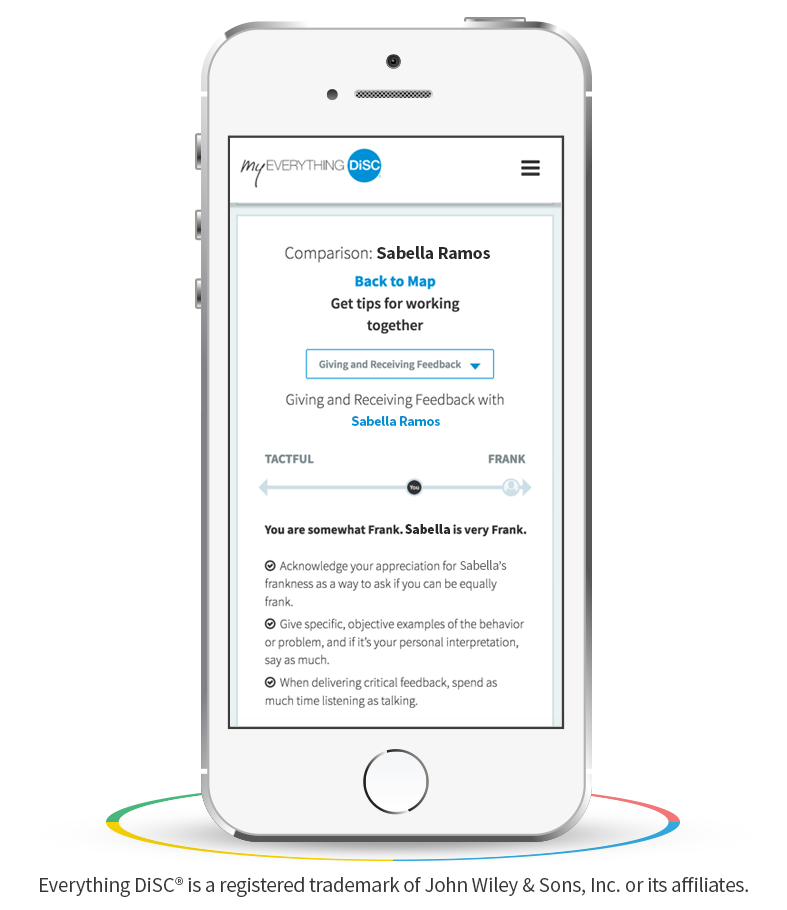
Compare styles with a colleague
Two colleagues compare their DiSC® styles and read tips for working together, including tips on managing tension.
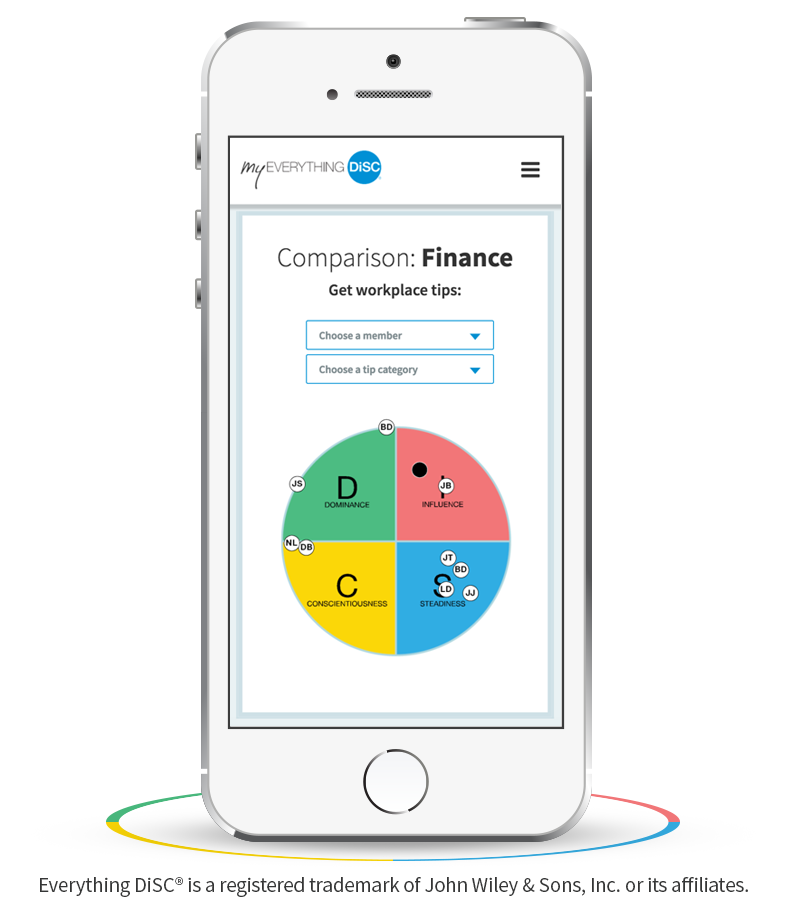
See the group on one map
Participants see where the members of a group sit on the DiSC® map.
HOW IT WORKS
From order to personal plan in four steps
1
Order, then a logistics call
The first step after your order is a call with Symphony 100 to go through the logistics: who is taking part, how the assessments go out, and what your group wants from the workshop.
2
Everyone completes the assessment
Every participant completes the Everything DiSC® Productive Conflict assessment. Symphony 100 confirms that all the assessments are in before the workshop is scheduled.
3
Schedule the sessions
Once the assessments are complete, Symphony 100 schedules the three live sessions with you.
4
Three live sessions, then keep going
Participants move from their style in conflict, through destructive responses, to a changed response. Each participant keeps a MyEverythingDiSC® account and a personal plan.
PRICING
One price for your cohort
Productive Conflict Workshop Package Up to 10 participants: three live sessions and 10 Productive Conflict profiles
$5,000
Extra participants Add up to 2 more people, for a dozen participants
+$180 each
Prices are in US dollars. Sales tax, where applicable, is calculated at checkout.
Why we keep cohorts small
The best learning happens in engaging, interactive groups where every participant is seen, heard and involved. Each workshop is built around 10 participants, with the option of adding 2 more for a dozen. Twelve is the breaking point: beyond a dozen, the quality of the discussion drops.
More than 12 people, or something different?
Order one package per cohort; several cohorts can run in parallel or one after another. Workshops are delivered remotely. Other arrangements (including in-person) and anything else customized are by custom quote on a call: Coaching, Consulting & Program Services →
Not sure this is the right package?
Book a 20-minute Everything DiSC® intro call with Frank November. Bring your group, your goals, and your timeline, and leave knowing which option fits.




 Leaders and managers
 Aspiring leaders
 A team under pressure
 HR and people teams